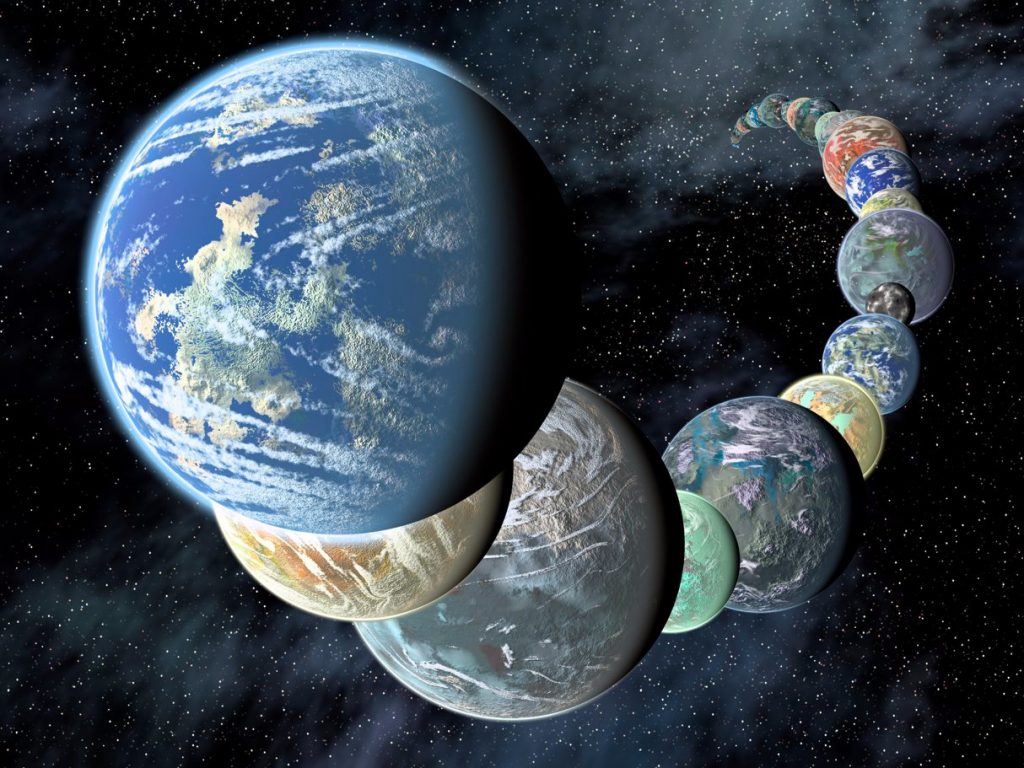
Kepler is a space observatory launched by NASA to discover Earth-size planets orbiting other stars. Named after astronomer Johannes Kepler, the spacecraft was launched on March 7, 2009,into an Earth-trailing heliocentric orbit. The principal investigator was William J. Borucki.
- Gliese 581d
- Gliese 581d /ˈɡliːzə/ (often shortened to Gl 581d or GJ 581d) is a possible extrasolar planet orbiting within the Gliese 581 system, approximately 20.4 light-years away in the Libra constellation. It is the third planet claimed in the system and (assuming a six-planet model) the fifth in order from the star.
- HD 85512b
- HD 85512 b is an exoplanet orbiting HD 85512, a K-type main-sequence star approximately 36 light-years from Earth in the constellation of Vela.
- Kepler -69c
- Kepler-69c(also known by its Kepler Object of Interest designation KOI-172.02) is a confirmed super-Earth extrasolar planet, likely rocky, orbiting the Sun-like star Kepler-69, the outermost of two such planets discovered by NASA's Kepler spacecraft. It is located about 2,700 light-years (830 parsecs, or nearly 2.5544×10¹⁶ km) from Earth in the constellation of Cygnus. The exoplanet was found by using the transit method, in which the dimming effect that a planet causes as it crosses in front of its star is measured. Initial discovery of the planet was announced on January 7, 2013] confirmation was announced on April 18, 2013. Although it was initially thought to be in the habitable zone, it is now thought to represent a super-Venus, analogous to Venus but more massive, and thus highly unlikely to be habitable for life.
- Tau ceti e
- Tau Ceti, Latinized from τ Ceti, is a single star in the constellation Cetus that is spectrally similar to the Sun, although it has only about 78% of the Sun's mass. At a distance of just under 12 light-years (3.7 parsecs) from the Solar System, it is a relatively nearby star, and is the closest solitary G-classstar.The star appears stable, with little stellar variation, and is metal-deficient.
- Gliese 667 cf
- Gliese 667 (142 G. Scorpii) is a triple-star system in the constellation Scorpius lying at a distance of about 6.8 pc (23.6 ly) from Earth. All three of the stars have masses smaller than the Sun. There is a 12th magnitude star close to the other three, but it is not gravitationally bound to the system. To the naked eye, the system appears to be a single faint star of magnitude 5.89.
- kepler -62f
- Kepler-62f (also known by its Kepler Object of Interest designation KOI-701.04) is a super-Earth exoplanet orbiting within the habitable zoneof the star Kepler-62, the outermost of five such planets discovered by NASA's Kepler spacecraft. It is located about 1,200 light-years (370 parsecs, or nearly 1.135×10¹⁶ km) from Earth in the constellation of Lyra.The exoplanet was found by using the transit method, in which the dimming effect that a planet causes as it crosses in front of its star is measured. Kepler-62f may be a terrestrial or ocean-covered planet; it lies within the outer part of its host star's habitable zone.
- Gliese 667cc
- Gliese 667 Cc (also known as GJ 667Cc, HR 6426Cc, or HD 156384Cc) is an exoplanet orbiting within the habitable zone of the red dwarf star Gliese 667 C, which is a member of the Gliese 667 triple star system, approximately 23.62 light-years (6.8 parsecs, or about 217,000,000,000,000 km) away in the constellation of Scorpius. The exoplanet was found by using the radial velocity method, from radial-velocity measurements via observation of Doppler shifts in the spectrumof the planet's parent star.
- kepler 62 e
- Kepler-62e (also known by its Kepler Object of Interest designation KOI-701.03) is a super-Earth exoplanet (extrasolar planet) discovered orbiting within the habitable zone of Kepler-62, the second outermost of five such planets discovered by NASA's Kepler spacecraft. Kepler-62e is located about 1,200 light-years (370 pc) from Earth in the constellation of Lyra.The exoplanet was found using the transit method, in which the dimming effect that a planet causes as it crosses in front of its star is measured. Kepler-62e may be a terrestrial or ocean-covered planet; it lies in the inner part of its host star's habitable zone
- Kepler 452 e
- Kepler-452 is a G-type main-sequence star located about 1400 light-years away from Earth in the constellation of Cygnus. It has a similar temperature to that of the Sun, but it is 20 percent brighter, 3.7 percent more massive and is 11 percent larger. It is approximately six billion years old, 1.5 billion years older than the Sun and also has a much higher metallicity. Thus, Kepler-452 can be considered a solar twin, however its age pushes it more back towards the "solar analog" criteria.
- Kepler 186 f
- Kepler-186f (also known by its Kepler Object of Interest designation KOI-571.05) is an exoplanet orbiting the red dwarf Kepler-186, about 550 light-years (171 parsecs, or nearly 5.298×10¹⁵ km) from the Earth. It is the first planet with a radius similar to Earth's to be discovered in the habitable zone of another star. NASA's Kepler spacecraft detected it using the transit method, along with four additional planets orbiting much closer to the star (all modestly larger than Earth).Analysis of three years of data was required to find its signal The results were presented initially at a conference on 19 March 2014 and some details were reported in the media at the time.The public announcement was on 17 April 2014, followed by publication in Science.

meron na bang natutuklsang bagong kamukha ng earth bukod diyan sa mga nasa information mo??
TumugonBurahinAs of now nothing.��
Burahinif there are earth like planets could it be habitable to humans
TumugonBurahinright?
Astronomers discovering continuously.
Burahinpwede bang tumira sa isa sa mga yan?
TumugonBurahinAstronomers discovering continuously.
Burahin